Evidence-Based Psychology in Equine-Assisted Practice:
From Therapeutic Principles to Experiential Learning
Integrating Evidence-Based Psychological Approaches with Equine-Assisted Experiences
At Blue Horse Equine Therapy, we believe that meaningful change can emerge when psychological science meets experiential learning and the unique opportunities for connection that horses offer.
Our approach integrates established principles from evidence-based psychological treatments, including Dialectical Behavior Therapy (DBT), Cognitive Behavioral Therapy (CBT), and Acceptance and Commitment Therapy (ACT), into thoughtfully designed, non-riding equine-assisted experiences.
Under the direction of a licensed psychologist with specialized training in equine-assisted services, our activities are designed to create opportunities to explore emotional awareness, self-regulation, communication, boundaries, psychological flexibility, and meaningful connection.
Horses offer something particularly valuable to this process: opportunities for immediate, embodied experiences of noticing, responding, adjusting, and connecting. Rather than simply talking about psychological concepts, participants can explore and practice them through interactions with horses, while respecting the horses' own needs, choices, and boundaries.
From Experience to Insight: Horse → Self → Life
A central component of the Blue Horse approach is guided reflection. Throughout our experiences, we invite participants to move through three interconnected levels of awareness:
1. HORSE — What did you notice about the horse?
We begin with curiosity and observation. What was the horse communicating through its body language, movement, or behavior? What seemed to help the horse feel comfortable or uncomfortable? How did the horse respond to the environment and to interactions with others? This first step encourages mindful attention, nonjudgmental observation, and respect for another living being's experience.
2. SELF — What did you notice about yourself?
Next, we turn our attention inward. What thoughts, feelings, or physical sensations arose during the interaction? How did you respond when something unexpected happened? What did you notice about your own communication, expectations, boundaries, or ability to regulate your emotions? This step encourages self-awareness, embodiment, emotional understanding, and reflection on patterns of thinking and responding.
3. LIFE — Where might this show up in your everyday life?
Finally, we explore how insights from the experience might connect with life beyond the barn. Where do similar patterns arise in relationships, school, work, or other challenging situations? What skills or perspectives might be helpful in those moments? What could you practice differently? This step helps participants consider how experiential learning might translate into meaningful choices and actions in everyday life.
The Blue Horse Approach: Curiosity, Communication, Coordination, and Connection
Our work is also guided by four interconnected processes:
Curiosity and Contact → Communication → Coordination → Connection
We begin with curiosity rather than assumptions, allowing time to observe, orient, and establish a sense of safety. Through communication, we learn to notice and respond to both verbal and nonverbal signals. Coordination invites us to adjust our actions in relationship with another living being. Through these experiences, opportunities for authentic connection can emerge.
These processes are not necessarily linear. Participants and horses may move back and forth among them as they learn, adapt, and respond to one another.
Bringing Psychological Science Into the Experience
The following sections illustrate how principles and skills from DBT, CBT, and ACT can be incorporated into equine-assisted activities. Each approach offers a different framework for understanding human experience, while the interactions with horses create opportunities for observation, practice, reflection, and learning.
Importantly, although DBT, CBT, and ACT have established research foundations, their integration with equine-assisted services remains an evolving area of practice and research. Our goal is to thoughtfully apply established psychological principles within ethically grounded, trauma-informed experiences that respect both human and equine welfare.
At Blue Horse Equine Therapy, the horse is not simply a tool for teaching. The horse is a living, feeling participant in a relationship that invites curiosity, awareness, choice, and connection.

Dialectical Behavior Therapy (DBT) and Equine-Assisted Experiences
Practicing Mindfulness, Emotion Regulation, Distress Tolerance, and Interpersonal Effectiveness
Dialectical Behavior Therapy (DBT), developed by psychologist Marsha Linehan, is an evidence-based psychological treatment that emphasizes the balance between acceptance and change. DBT teaches practical skills for managing difficult emotions, navigating challenging situations, developing healthy relationships, and responding effectively to life's demands.
At Blue Horse Equine Therapy, we integrate DBT principles and skills into carefully designed, non-riding equine-assisted experiences. Interacting with horses offers opportunities to practice these skills in real time, bringing awareness to our thoughts, emotions, physical sensations, and behavioral responses. Horses communicate primarily through body language and behavior. Learning to observe their signals, respect their boundaries, and adjust our own responses can provide meaningful opportunities to explore DBT skills.
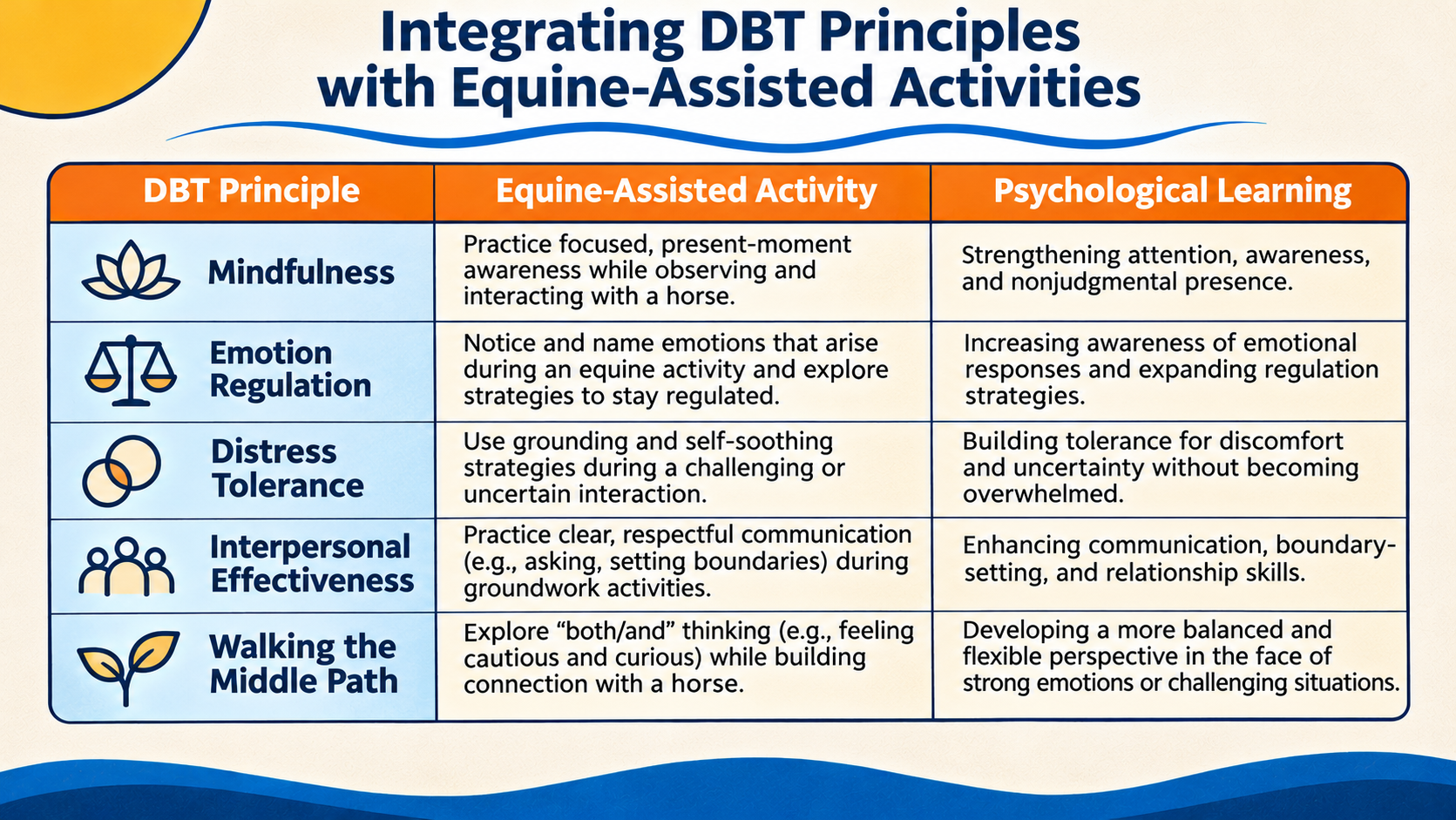
Integrating the Four DBT Skills Module
Mindfulness- Observe a horse quietly, noticing its breathing, movement, posture, and responses without immediately interpreting or judging them.Practicing observing, describing, participating, and attending to the present moment without judgment.
Distress Tolerance- When a horse hesitates, moves away, or does not respond as expected, pause, ground yourself, and practice accepting the situation without forcing an outcome.Tolerating uncertainty, practicing radical acceptance, and choosing skillful responses rather than reacting impulsively.
Emotion Regulation- Notice emotional and bodily responses during an interaction. Identify the emotion, consider what prompted it, and practice regulating your response before continuing.Identifying emotions, understanding emotional responses, checking the facts, and selecting effective actions.
Interpersonal Effectiveness- Practice communicating requests, recognizing the horse's boundaries, adjusting expectations, and working collaboratively during a groundwork activity.Developing clear communication, boundary awareness, relationship effectiveness, and respect for oneself and others.
Bringing DBT Skills to Life: Horse → Self → Life
Following each activity, participants are invited to reflect on their experiences using the Blue Horse framework.
HORSE — What did you notice about the horse?
What signals did the horse communicate? How did the horse respond to your actions? What did you notice when you paused, changed your approach, or allowed the horse to make a choice?
SELF — What did you notice about yourself?
What emotions, thoughts, or physical sensations arose? Did you feel impatient, uncertain, calm, excited, or frustrated? How did you respond? Which DBT skills helped you navigate the experience?
LIFE — Where might this show up in your everyday life?
When do you experience similar emotions or interpersonal challenges? How might mindfulness, distress tolerance, emotion regulation, or interpersonal effectiveness help you respond differently in those situations?
Acceptance and Change: The Heart of DBT
One of the central dialectics of DBT is learning to accept reality as it is while also working toward meaningful change. Horses can provide opportunities to explore this balance. We cannot always control how a horse responds, just as we cannot control every circumstance or relationship in our lives. We can, however, notice what is happening, regulate our own responses, communicate effectively, and make thoughtful choices about what to do next. Sometimes the most meaningful moment in an equine-assisted experience is not when the horse follows our request, but when we recognize that something needs to change in our own approach

Cognitive Behavioral Therapy (CBT) and Equine-Assisted Experiences
Exploring the Connections Between Thoughts, Emotions, and Behaviors
Cognitive Behavioral Therapy (CBT) is an evidence-based psychological approach that explores how our thoughts, emotions, and behaviors influence one another. CBT helps individuals recognize unhelpful thinking patterns, evaluate assumptions, develop coping strategies, and practice more adaptive responses.
At Blue Horse Equine Therapy, we integrate CBT principles into non-riding equine-assisted experiences. Interactions with horses provide opportunities to notice automatic thoughts, explore expectations, test assumptions, and experience how changes in thinking and behavior can influence an interaction.
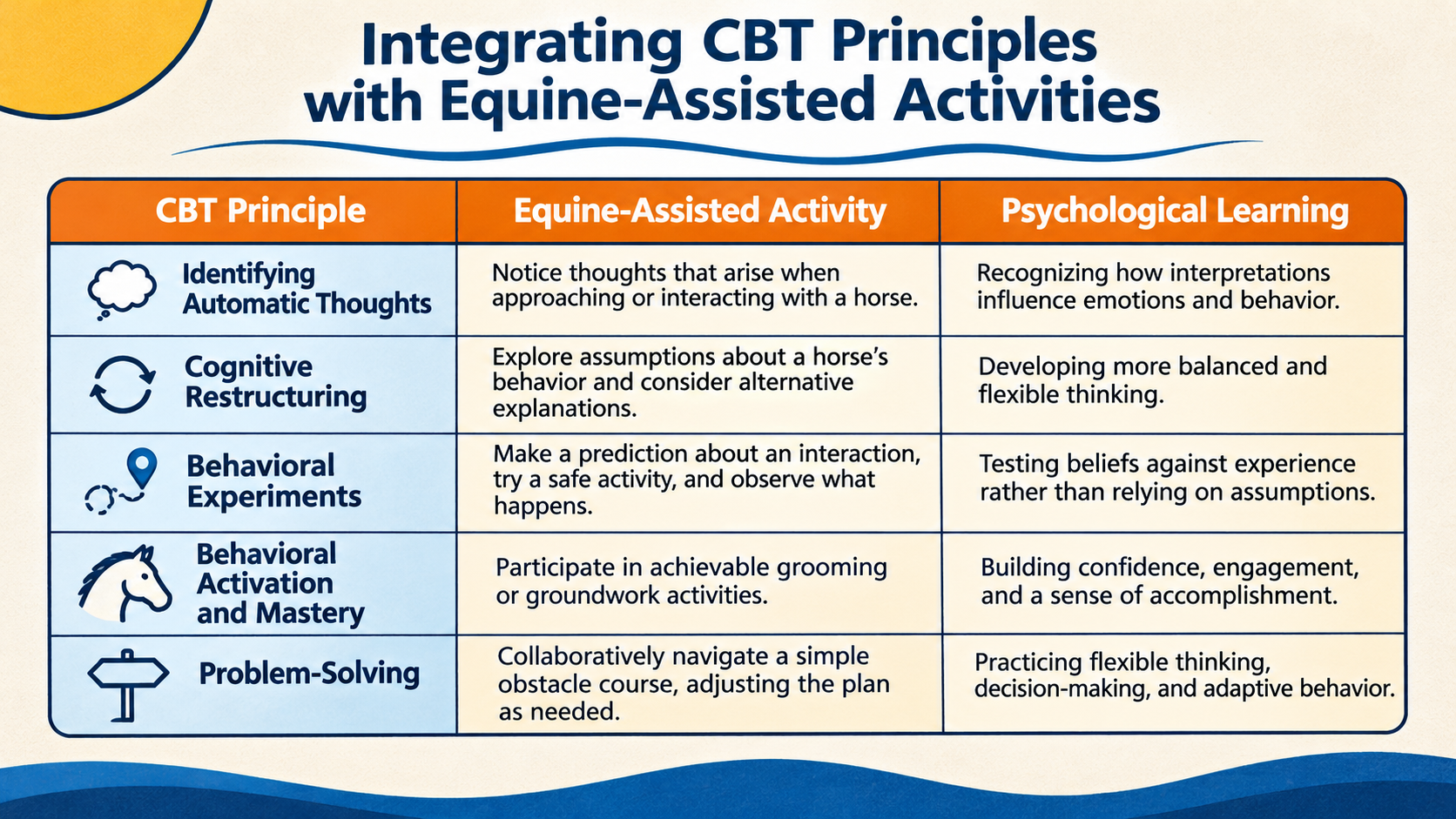
CBT Framework- From Experience to Everyday Life
Using our Horse → Self → Life reflection framework, participants explore what they observed about the horse, what they noticed about their own thoughts and responses, and how these patterns might appear in everyday situations.
The goal is to move beyond recognizing thinking and behavioral patterns toward practicing new ways of responding—with curiosity, flexibility, and awareness.
CBT-informed equine-assisted activities incorporate established CBT principles. They are not, by themselves, equivalent to a comprehensive CBT treatment protocol.

Acceptance and Commitment Therapy (ACT) and Equine-Assisted Experiences
Cultivating Psychological Flexibility, Acceptance, and Values-Based Action
Acceptance and Commitment Therapy (ACT) is an evidence-based psychological approach that promotes psychological flexibility- the ability to remain present, make room for difficult thoughts and emotions, and take meaningful action guided by personal values.
At Blue Horse Equine Therapy, we integrate ACT principles into non-riding equine-assisted experiences. Horses offer opportunities to practice present-moment awareness, navigate uncertainty, recognize thoughts without becoming controlled by them, and make intentional choices that reflect personal values.
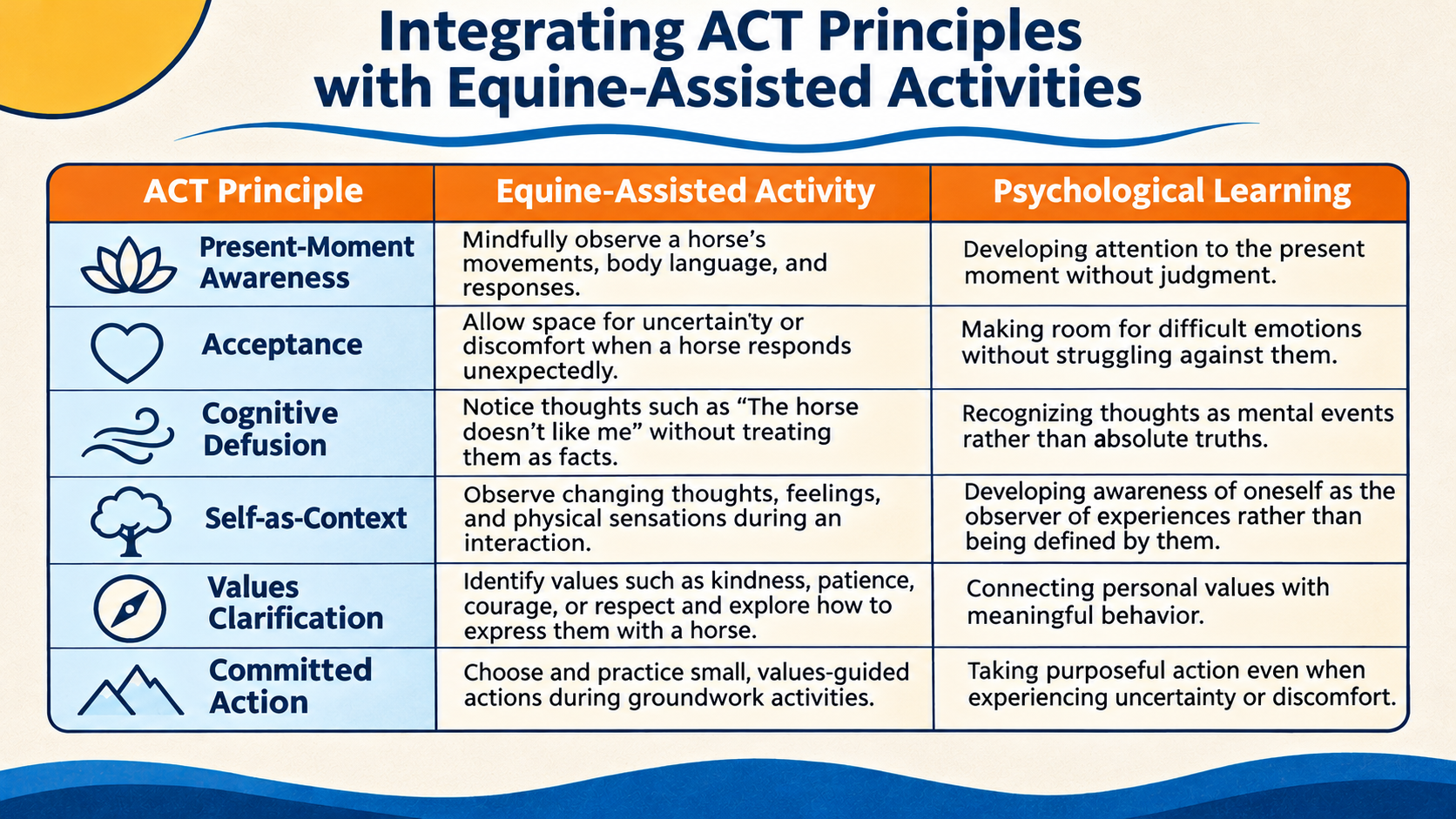
From Experience to Everyday Life
Using our Horse → Self → Life reflection framework, participants consider what they noticed about the horse, how they responded internally, and how the experience connects with their values and choices in everyday life.
The goal is not to eliminate uncomfortable thoughts or feelings, but to develop greater flexibility in responding to them while moving toward what matters most.
ACT-informed equine-assisted activities incorporate established ACT principles. They are not, by themselves, equivalent to a comprehensive ACT treatment protocol.
Beyond the Therapy Room: Why Horses?
At Blue Horse Equine Therapy, we believe that psychological growth doesn't have to happen only on a couch or within the four walls of a therapy room. Sometimes, meaningful learning happens outdoors, in the presence of another living being, where psychological concepts become experiences we can feel, explore, and practice.
Horses offer unique opportunities for this kind of learning. As social, sensitive, and responsive animals, they invite us to pay attention—not only to their communication, boundaries, and needs, but also to our own thoughts, emotions, physical sensations, and patterns of behavior.
In the presence of horses, we can practice mindfulness rather than simply discuss it. We can notice frustration, uncertainty, or fear as it arises and explore how we respond. We can practice patience, flexibility, communication, and respect for boundaries within an authentic relationship with another living being.
This is where DBT, CBT, and ACT come together. Each offers a different pathway toward greater awareness, psychological flexibility, emotional regulation, and meaningful action. Equine-assisted experiences create opportunities to bring these principles into the body, into relationships, and into real-world practice.
Nature adds another dimension. Stepping outside traditional clinical spaces invites movement, sensory awareness, curiosity, and connection with the world around us. The experience is not simply about learning skills; it is about exploring how those skills can become part of the way we live.
And importantly, horses are not instruments for achieving human goals. They are sentient partners whose preferences, boundaries, and well-being matter. Learning to recognize and respect their experiences is itself an important part of the work.
At Blue Horse Equine Therapy, we bring psychological science out of the therapy room and into meaningful, embodied experiences- where we can learn with horses, connect with ourselves, and carry those insights into everyday life.